



Collins Bowl - Bonn University Academic Art Museum
The Corinthian bowl collected by the Academic Art Museum of the University of Bonn is an ancient Greek pottery dating back to around 575 BC, representing the pinnacle of pottery production during the Corinthian period. The excavation location of this bowl is unknown, but its exquisite craftsmanship and decoration showcase the superb skills of ancient Greek potters. The bowl wall is very thin, the bottom is low, the belly is spherical, the mouth edge is noticeably outward sloping, and there are handles installed horizontally on both sides. The bowl is adorned with a circular decorative strip, with two to three groups of warriors depicted on one side and riders galloping to the left on the other side. These patterns not only beautify pottery, but also reflect the wars, myths, and nature worship of ancient Greek society

Collins style wine jug - Academic Art Museum of Bonn University
A Corinthian wine jug, collected at the Academic Art Museum of the University of Bonn, is a pottery piece produced in Corinth between 625 BC and 600 BC. Collins was a leader in pottery production at that time, and its products were widely exported throughout the Mediterranean region. The specific location where this pottery was unearthed is unknown. It is a pot with a three leaf shaped mouth edge and a sometimes upturned strap handle, which connects the mouth edge and shoulder. The black painting technique invented by Collins was used for drawing. It is an important type of ancient Greek pottery, and its design and decorative style reflect the prosperity of Greek culture and art.
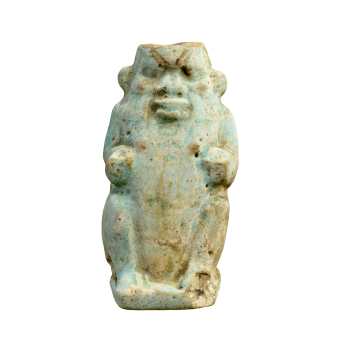
University of Bonn Academic Art Museum Bass Image Vessel
It is an ancient artwork collected by the Academic Art Museum of Bonn University. The vessel depicting the image of bass was made between 550 BC and 600 BC, and is likely to have been discovered in Nocratis. Made of glazed pottery with a blue-green surface, this material floats on quartz sand during the firing process, forming a texture similar to glaze. Glazed pottery was already produced in Egypt around 4000 BC, and there was a proposal from Naukratis to establish a workshop. However, this work is likely to have been produced in the Eastern Greek region, and there have been proposals to establish a studio in Rhodes. It showcases the image of the Egyptian god Bess, who is a deity with the ability to ward off evil spirits.

Bonn University Academic Art Museum Ancient Greek Pottery
A piece of ancient Greek pottery collected in the Academic Art Museum of Bonn University. This bowl is said to have been discovered at the Diplon Gate in Athens, around 750 BC to 735 BC, and was produced in the Attica region. This vessel is characterized by steep edges and a horizontal band like handle. The upper wall is divided into panels with stars, Capricorn, swastika, and checkerboard patterns. The wide stripes between the handles are divided into three panels: a display zigzag band in the middle and birds on both sides. The handle itself is also decorated with a zigzag band. It is an outstanding representative of ancient Greek pottery art and an important physical evidence for studying ancient Greek culture and artistic style
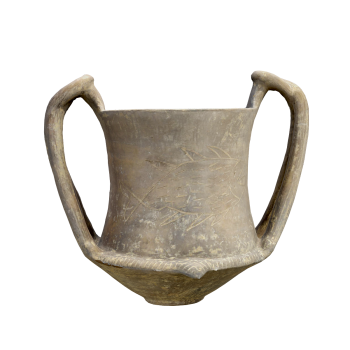
Cantalos Ancient Greek Wine Cup
It is a drinking cup from ancient Greece and is currently housed in the Academic Art Museum of Bonn University. Discovered in a tomb in Falerii Veteres, dating back to the mid-7th century BC to the latter half of the year, made of brownish red coarse clay. The cup body is concave and cylindrical, and the handle is arched and higher than the cup mouth. The bottom is separated from the cup wall by a circular coil, which displays vertical scratches and decorative knobs. There is a fish scratched on each side of the cup wall of the container. Not only is it an example of ancient Greek drinking culture, but it is also an outstanding representative of ancient Greek pottery art.

Kiyasos Ancient Greek drinking vessels
It is a cup-shaped drinking vessel from ancient Greece, dating back to around 550 BC to 500 BC, produced in the Attica region. The location is unknown. The characteristic of Kiassos is that the cup mouth is upturned, originating from the shape of a spoon. The upper end of its handle has a spike to securely fix the vessel. The characteristic is that the cup mouth is upturned, originating from the shape of a spoon. The upper end of its handle has a spike to securely fix the vessel. It is currently housed in the Academic Art Museum of the University of Bonn. Using black painting techniques, the scene depicts the battle between Hercules and Amazon female warriors.

Laconia Kilix Cup
It is an ancient Greek pottery collected in the Academic Art Museum of Bonn University. Made between 550 BC and 530 BC, originating from the ancient Laconia region where Sparta was located. Known for its white coating and decorations concentrated on the inside of the bowl. The outer side of the cup presents a beam of light and several dark stripes of different widths. The inside displays a scene depicting two bearded, naked men talking. The smaller man on the left has a long beard and holds a Cantalos in one hand. The larger man on the right has a short beard and is not carrying any items. The blank space around the man is filled with bird and floral elements

Prototype Geometric Lequitos Bottle
It is an ancient Greek pottery, collected in the Academic Art Museum of Bonn University. This Lechitos bottle can be traced back to the prototype geometry period of the 9th century BC and was made in the Athens region. Known for its simple geometric patterns and decorative style, these patterns typically include lines, circles, and simple shapes. As a typical representative of this period, it showcases the skills and artistic aesthetics of ancient Greek ceramic artists. These pottery bottles are not only practical containers, but also valuable materials for studying ancient Greek culture and religious customs.

Saint Valentine's Cup
It is an ancient Greek pottery cup collected by the Academic Art Museum of Bonn University, dating back to the late 5th century BC or early 4th century BC. Belonging to the so-called Saint Valentine Cantalos Cup category, it is characterized by a bell shaped body and a vertically installed handle that connects the rim of the cup to the lower part of the cup body. It may have been produced based on the prototype of Attica in Attica or Apulia region. Each side has decorative panels, with Ionic vortex patterns on the upper and lower edges, and the middle area filled with laurel and ivy wreaths and dotted lines. It showcases the exquisite craftsmanship of ancient Greek pottery and reflects the aesthetic style of the time.

Popular Models


Honey Badger (3D animated model)
194 View

Guinea fowl (3D animated model)
165 View

Wild Goose (3D animated model)
187 View

Red Fox (3D animated model)
155 View
Random Model

Fujifilm Instax WIDE 300 Polaroid Camera
1068 View

Swimming pool escalator
881 View


Carhart Workwear Boots
517 View

Retro Creative Alarm Clock
738 View



The Khotke Family Tomb in Czech Republic
1081 View

Indian Bajaj Hand Sewing Machine
1349 View